Going back to The How of Making Things, when something is being made, it is necessary to make choices about what and how it is going to be. Today we rarely have to make things ourselves; we have many stores and options to buy (as long as we have the money), yet the principle still holds.
For example, take something as simple as finding a place for your couch. Take away all interior designers and decorating magazines, and you still have to look at your room and your couch and picture different places – some very practical – “Does it fit on this wall?” – and others of your preference – “I hate it next to the window!”
The ancient persons who made pottery all over the world in every culture had to answer questions. Remember the Greek hydria?
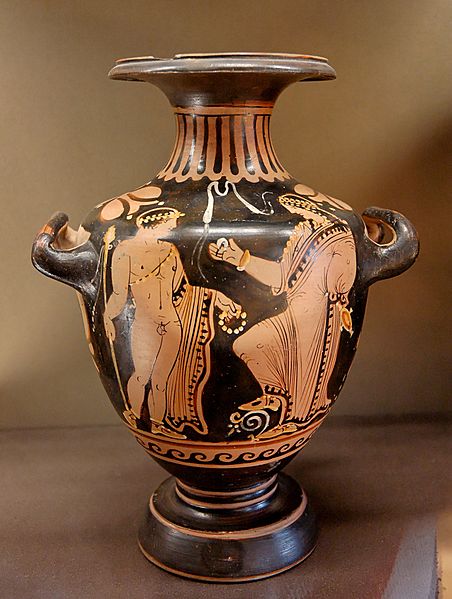
It needs to stand on the ground – so there is a base. It needs to have space to hold the water – so there is the big middle part. The water needs to be poured without much spilling – so there is small neck. Let’s add some handles on the side as well. Oh, and now let’s paint all over it.
Now consider this.

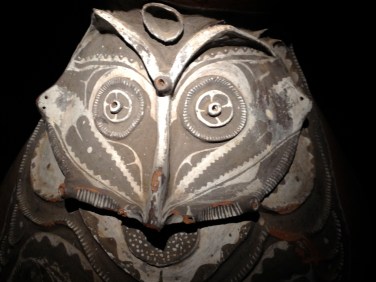
This object is exhibited at the Bowers Museum of Cultural Art in Santa Ana, CA. It is a jar for storing food or water made and used by people living in Papua New Guinea.
Notice how similar it is to the Greek hydria – base to stand on, big main body, neck at the top, and images on the main body. Yet how different – the shape of the main body is reversed, neck isn’t long, and all the carvings! So very different!
If you look at more such objects from the respective areas and time periods, you will see that all Greek hydriai look more similar to other Greek hydriai than any Papua New Guinea jar, and vice versa. So how is that possible? If the practical needs of storing water were the only considerations and a human being is anatomically the same everywhere in the world, then the two vessels should be the same. But they are not the same, because a human being has an individuality – the thing we call character – that separates it from any other human being – and that character is shaped in many ways by its surroundings – something we call culture. And as I will show later, the practical needs of storing water are not the only considerations in making the jar.
Look at the plaque that describes the Papua New Guinea jar: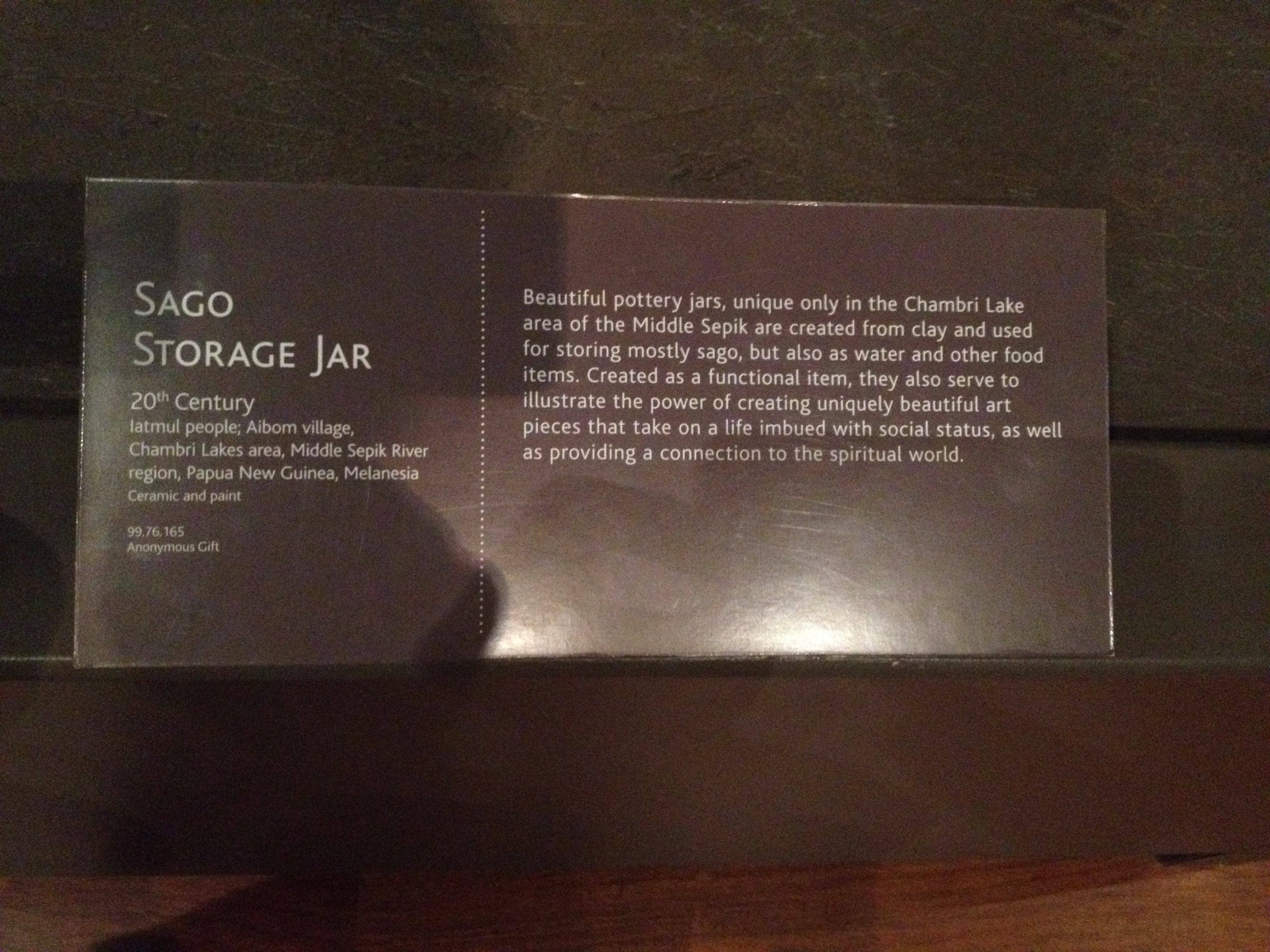
Notice the words “status” and “spiritual world”. Status is not an object like a jar or a pen, yet it is something very real. And what do they mean by “spiritual world”?
Here we reach the place of the invisible.
 Art and the Invisible