Dear reader,
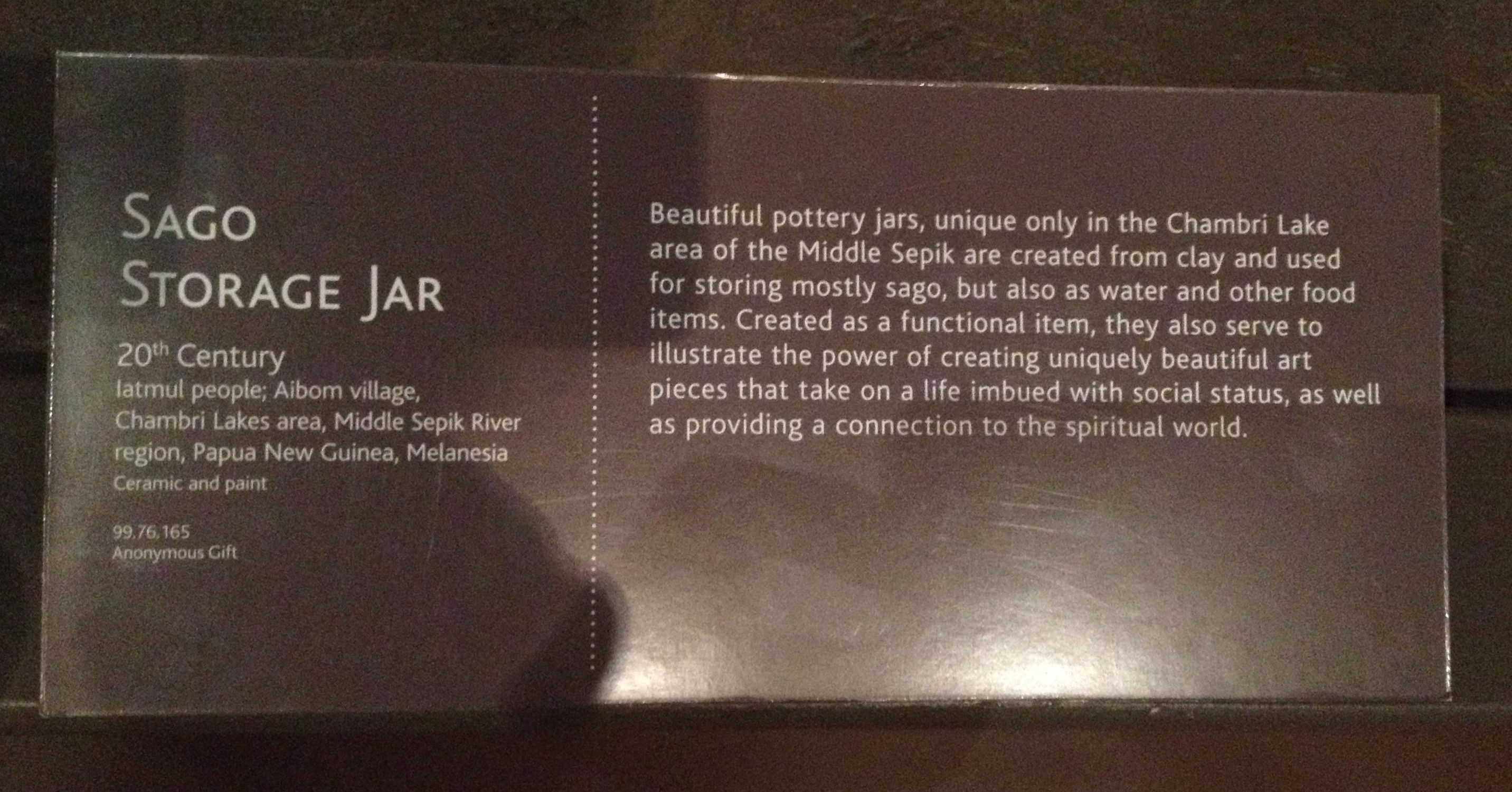
When I showed you the picture of the Papua New Guinea sago jar two weeks ago, I posted the description that went along with it as well. It read the following: “Created as a functional item, they also serve to illustrate the power of creating uniquely beautiful art pieces that take on a life imbued with social status, as well as providing a connection to the spiritual world.”
As I mentioned before, I’ve reached the place to talk about the invisible in the title of the blog. Look at the description above and consider the word “status”. Is status something you can see? No, it isn’t. Take a military general, for example. If he is dressed in his uniform, and I happen to know what the attributes of a general look like, I would recognize that he has great control over the position of some part or maybe even all of the US military. That is his status – it gives him the ability to be in command. But I never saw status itself; all I saw is one or more stars attached to the shoulders of a jacket. There are plenty of fashion pieces that have stars on the shoulders! That doesn’t make their owner a general in the US army.
Now consider the same man, the general. In a hypothetical situation, let’s say I see him giving commands to others and they rush to follow his orders, yet he isn’t dressed in his uniform for some reason. From his actions and the other people’s action, I will understand he is in charge – he has status over them, even if he is dressed in his undershirt. Yet again, I didn’t see status as something tangible – light in my eyes reflected by an object. I saw actions and reactions, and through them I understood that one person had the status of being in charge of the others.
So this is what I call invisible things in this blog. I am not talking about ghosts, or non-existing things conjured up by me, or anything like that. I am talking about all the things we use in daily life that cannot be touched with a hand or measured with a stick. Like status or government. You can’t touch something called government, yet it is involved in every part of life.
Any other examples you can think of?
 Art and the Invisible

So I was thinking about other examples of invisible things this week, and I meant to write this as early as Wednesday…, but here it is. How about ‘society’? Or ‘owner’? There is not a set of molecules to point to and say: ‘This is an owner.’ But an action of making or buying something can make an owner out of any person. Hence, an invisible thing.