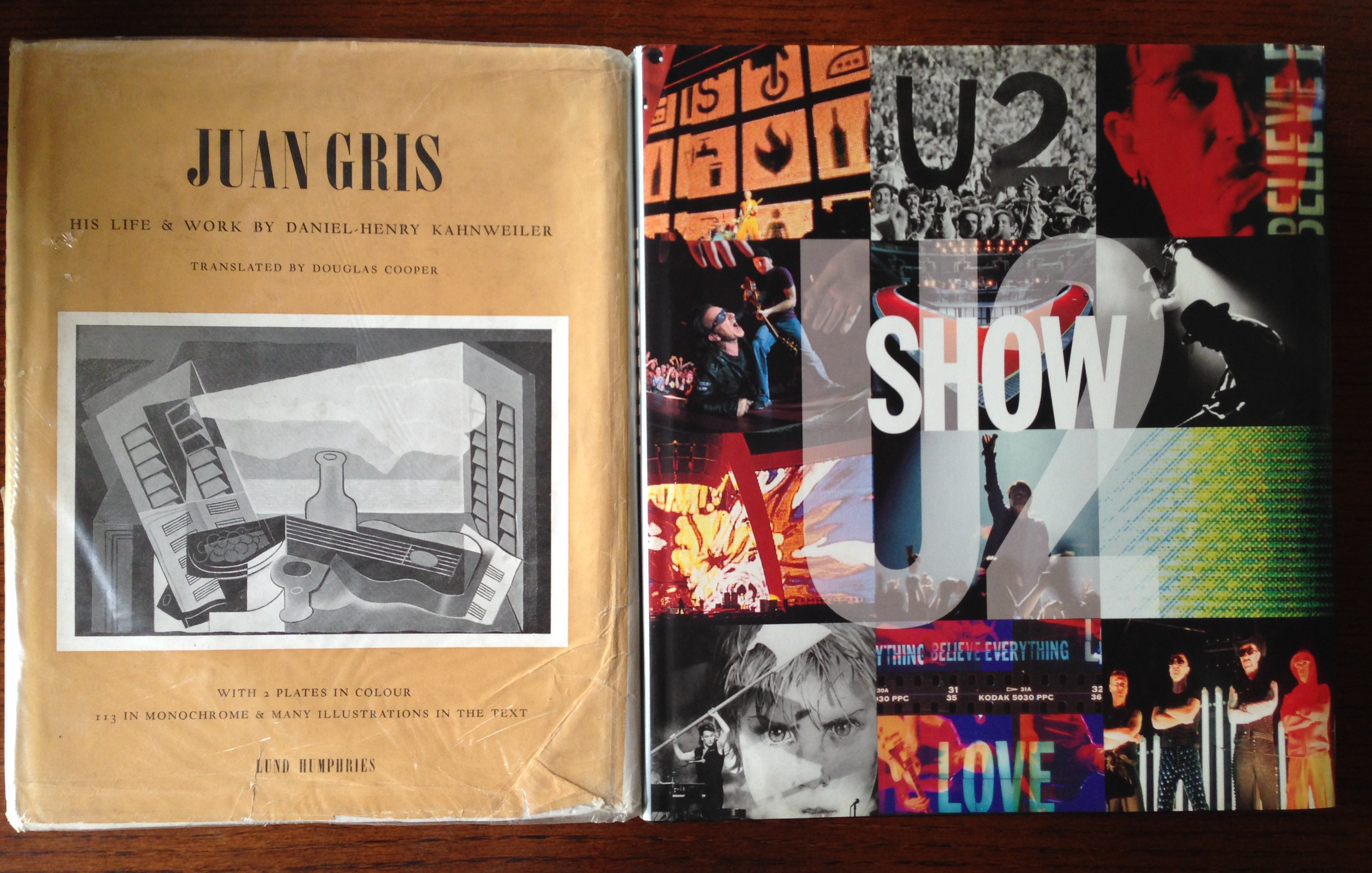
Daniel-Henry Kahnweiler was the art dealer who made Cubism famous. In his book “Juan Gris – his life and work”, he writes: Every plastic work of art is produced in response to the requirements of the spiritual community. (41) Later in the same chapter he writes: It remains for me to establish that this “appearance” [of the work of art] really corresponds to a projection of the spirit of the time. (55)
Now compare these statements with the following quote from the book “U2 Show”: As punk had laid waste to the idea of the big, spectacular rock show having any relevance to the modern world, so U2 would reinvent the genre as a richly ironic, politicized statement about the way we live now. Loosely, ZooTV and PopMart could be said to articulate statements about the postmodern world – describing that world back to itself… (Scrimgeour, 11)
Kahnweiler wrote in the first half of the XX-th century. At that time, the acceptance of a spiritual world – a reality that cannot be touched, seen, or measured, was still commonplace. Historically in the Western world, “spiritual” was connected with Christianity. Neither Kahnweiler, nor any of the artists he wrote about were Christians, yet some of them, Juan Gris included, would describe themselves as believers in the mystic (again, a word that describes a reality outside of the visible world.) Today the word “spiritual” is not used often. With the current anti-Christian attitude, it has been pushed out of the mainstream vocabulary, except when it refers to Asian, Eastern, tribal or mystic topics. With the growth of atheism, what was a common belief in a spiritual – i.e. invisible – reality has disappeared from the mainstream.
However, as I read the above quotes, they say the same thing – that something belonging to the domain of the artistic and creative, painting in one case, rock concert show in the other, is what it is in its shape and substance because it reflects real, recognizable and definable thoughts and mental pictures that are common to the people living at the particular time and place. For Kehnweiler that was “a spiritual community” and “the spirit of the time”. For Diana Scrimgeour it is “relevance to the modern world”, “the way we live now”, and “describing the world back to itself”. It is a reality we acknowledge and interact with, whether we agree on exactly what we call it or not. This is what I call “invisible reality” and why I believe the arts (in its broadest definition) is its reflection.
Now the question remains what is this invisible world and how do we interact with it? And why and how does it transfer itself into the arts?
 Art and the Invisible